How to Install Grating Clips Properly
Grating clips are widely used to secure steel grating panels to supporting structures. Proper installation ensures stability, prevents panel movement, and allows easy maintenance when removal is required.
As a professional Steel Grating supplier, we provide reliable fastening solutions for industrial flooring, walkways, platforms, and trench drain systems.
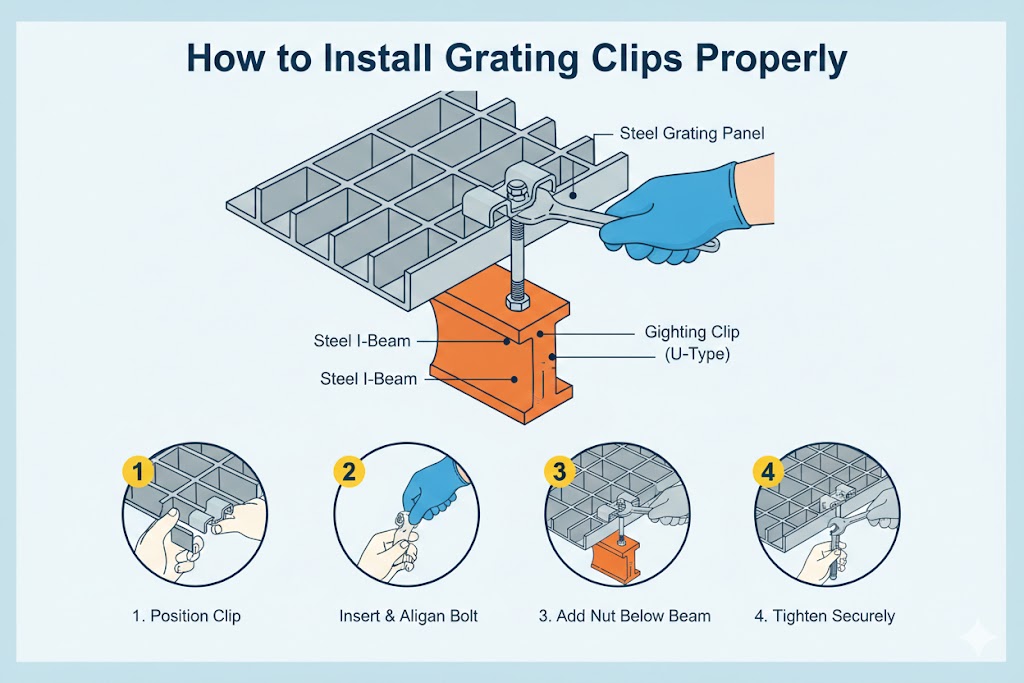
1. What Are Grating Clips?
Grating Clips & Fasteners are mechanical fixing devices designed to secure grating panels without welding. They are ideal for installations where panels may need to be removed for inspection or maintenance.
- Top saddle clip
- Bottom plate
- Bolts and nuts
2. Tools Required
- Wrench or socket tool
- Measuring tape
- Protective gloves
- Leveling tool
3. Installation Steps
Step 1: Position the Grating Panel
Ensure the grating panel is properly aligned and that the bearing bars are perpendicular to the support beams.
Step 2: Insert the Bottom Plate
Place the bottom plate underneath the support beam so it aligns with the top saddle clip.
Step 3: Place the Saddle Clip
Position the saddle clip over two adjacent bearing bars to hold the grating firmly against the support structure.
Step 4: Tighten the Bolt
Insert the bolt through the saddle clip and bottom plate, then tighten securely using a wrench. Avoid over-tightening to prevent deformation.
4. Recommended Fixing Spacing
For standard industrial applications, fixing points are typically installed at each corner of the panel and at intermediate supports for larger spans.
For heavy load areas using Heavy Duty Steel Grating, additional fixing points may be required to prevent displacement.
5. When to Use Clips Instead of Welding
- When future removal is required
- For galvanized surfaces where welding may damage coating
- For maintenance-access panels
- For temporary or modular installations
Conclusion
Proper grating clip installation improves safety and allows flexible maintenance. By following correct positioning and tightening procedures, steel grating systems can remain secure while retaining easy accessibility for inspection and service.