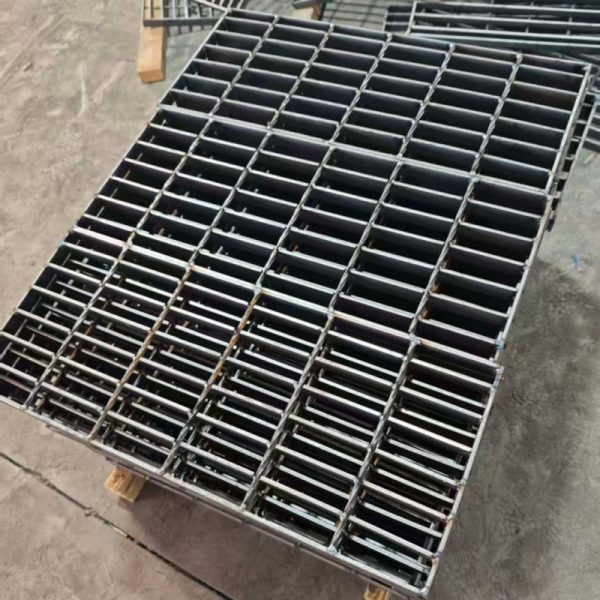
| Material Options | Mild Steel (Carbon Steel), Stainless Steel (304/316) |
|---|---|
| Bearing Bar Size | 25×3mm,25×5mm,30 ×3mm,32×3mm,32×5mm,40×3mm (Custom sizes available). |
| Bearing Bar Spacing | 30mm,40mm,50mm |
| Cross Bar Size | 6mm,8mm,10mm |
| Cross Bar Spacing | 30mm,50mm,100mm |
| Surface Treatment | Hot-Dip Galvanized (HDG), Powder Coated, Painted, or Untreated (Mill Finish). |
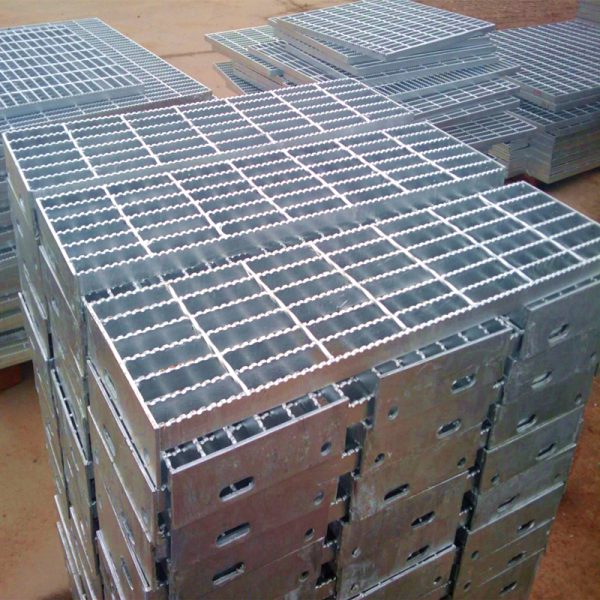
| Surface Profile | Plain (Smooth), Serrated (Non-slip) |
| Panel Dimensions | Standard Sizes: 600 ×250mm,700 ×250mm,700 ×300mm or 800 × 250mm(Custom sizes available). |
| Unique Advantages | High strength, anti-slip, durable, easy install, and excellent drainage. |
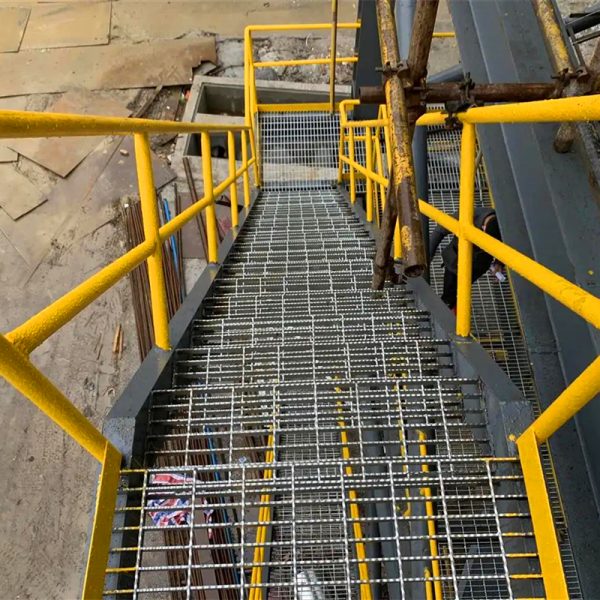
| Applications | Industrial platforms, fire escapes, public stairs, and maritime walkways. |
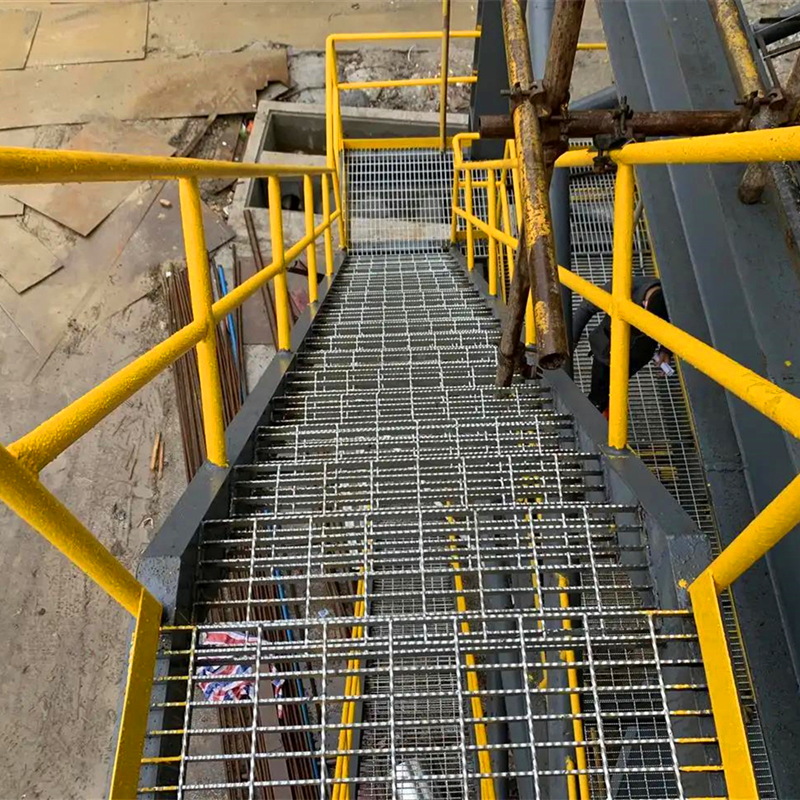
On industrial stairs, problems usually appear after installation:
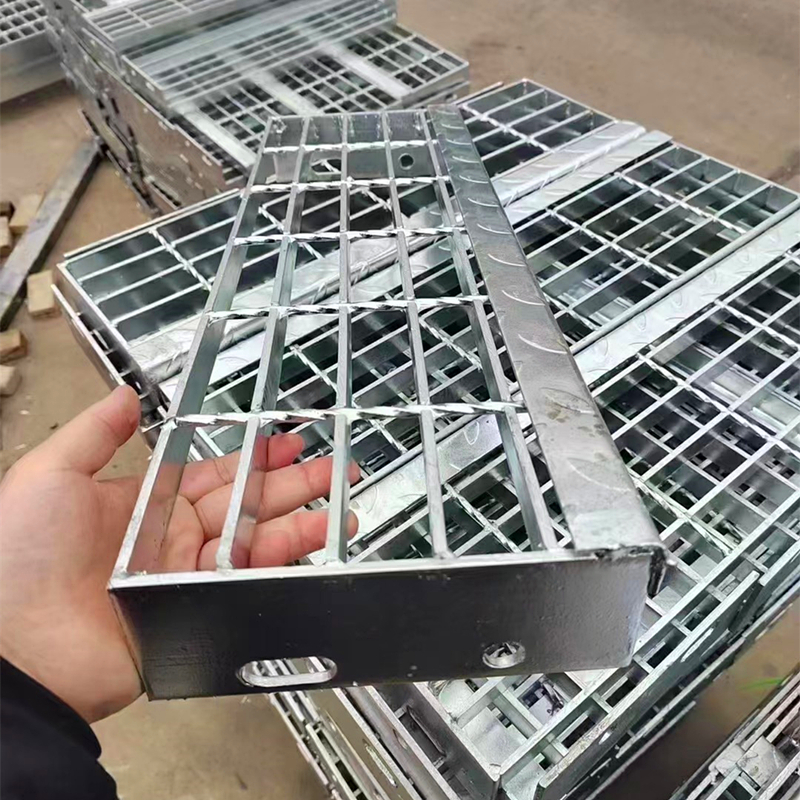
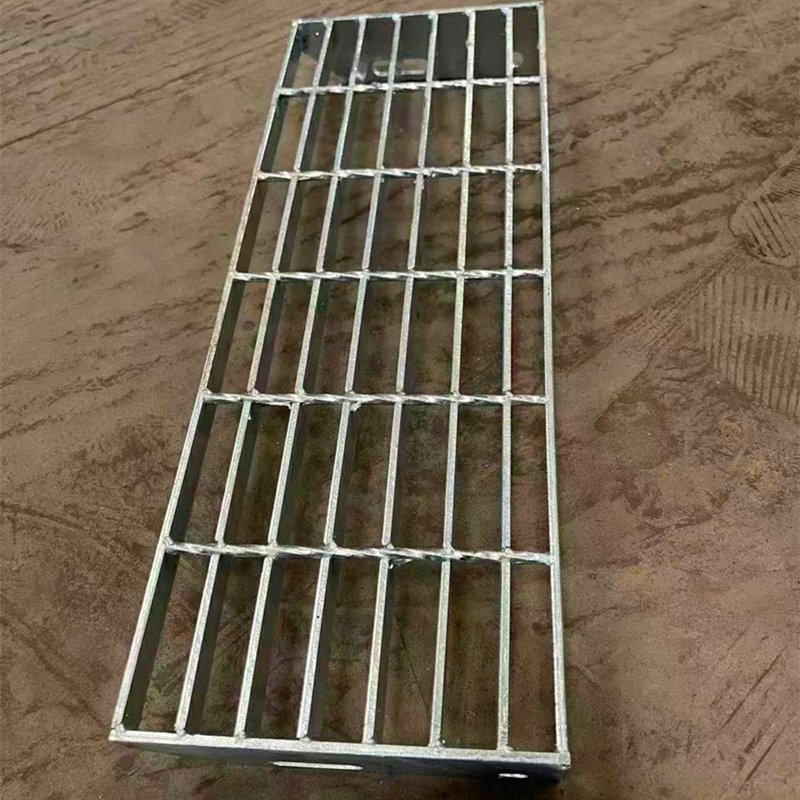
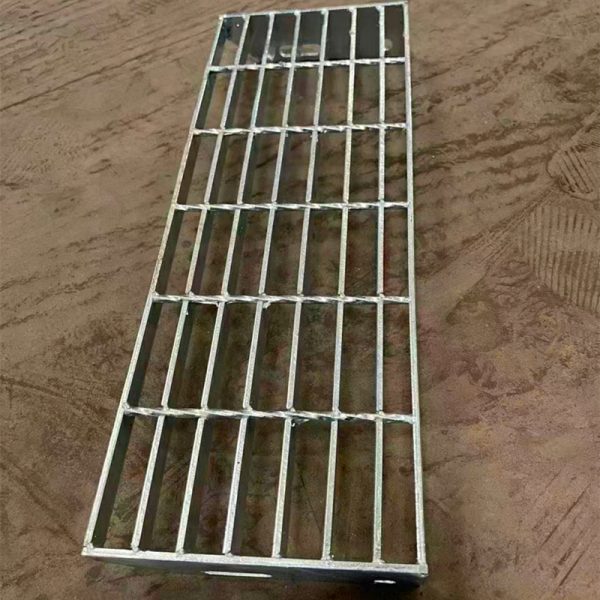
Grating stair treads address these issues by supplying a ready-to-install step unit.
Each tread is fabricated with:
If stairs must be installed quickly or under site restrictions, prefabricated stair treads reduce both labor time and alignment error.
This is why many projects now specify prefabricated stair treads for steel stairs instead of site-built solutions.
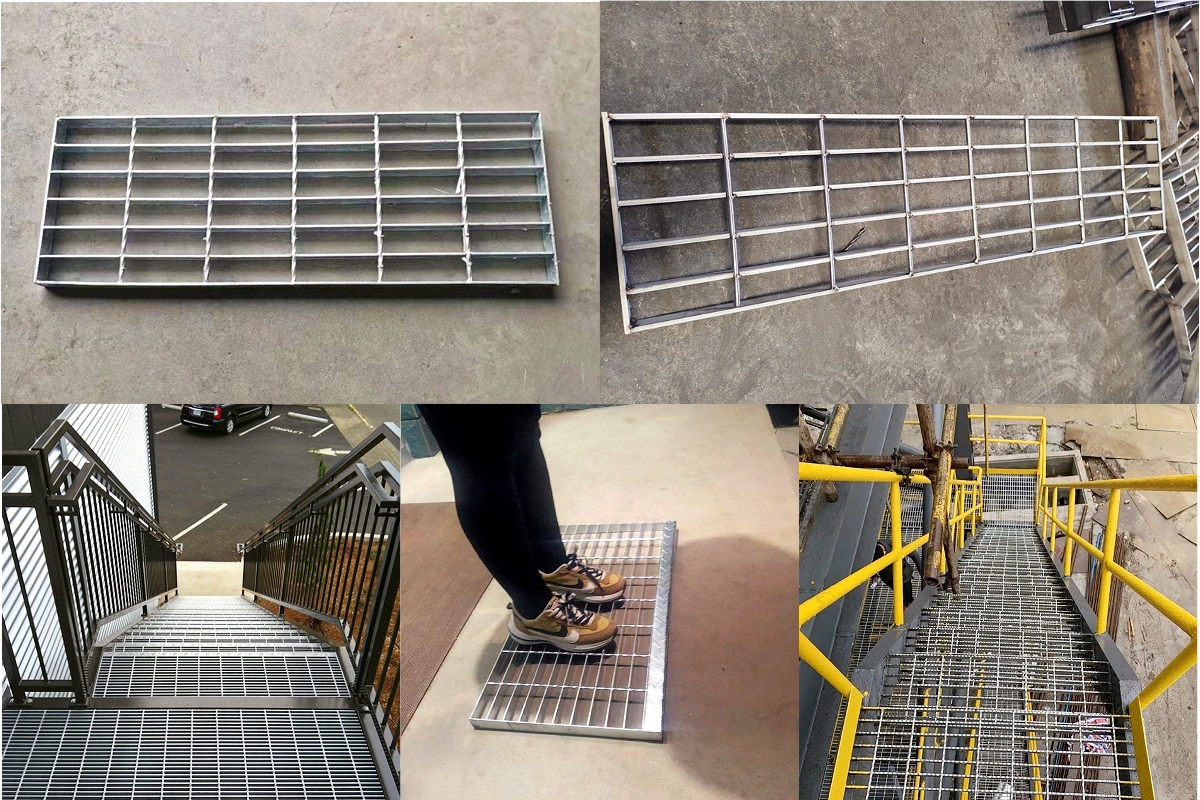
Slip risk is highest at the front edge of the step.
Our anti-slip stair treads are available with:
These designs increase the coefficient of friction exactly where load is applied during stepping.
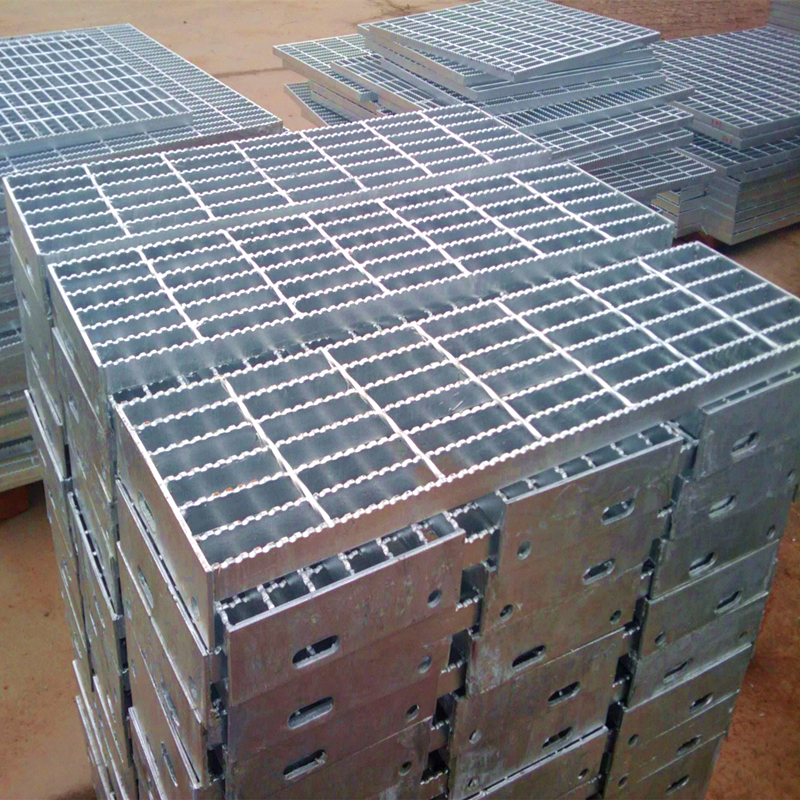
As shown in our production photos, the nosing also improves visibility, helping users identify step edges under low-light or outdoor conditions.
Compared with flat-edge steps, industrial stair treads with nosing provide a measurable improvement in slip resistance.
End plates determine how the tread transfers load to the stair stringer.
Available options:
For retrofit or maintenance platforms, bolt-on stair treads allow replacement without cutting or welding.
If welding is restricted on site, bolted designs simplify installation while maintaining structural integrity.
Industrial stairs are exposed to:
For this reason, most steel stair treads for industrial use are protected by hot-dip galvanizing.
This ensures long-term resistance to corrosion, especially at edges and connection points where failure typically begins.
| Parameter | Specification |
| Product Type | Prefabricated grating stair treads |
| Bearing Bar Size | 25×3 mm / 30×3 mm / 32×5 mm / 40×5 mm |
| Bearing Bar Thickness | 3 mm – 5 mm |
| Tread Depth | 240 mm / 270 mm / 300 mm |
| Length Range | 600 mm – 1200 mm |
| Mesh Size | 30×100 mm / 40×100 mm |
| Material Options | Carbon Steel / Stainless Steel |
| Surface Finish | Hot-Dip Galvanized / Mill Finish |
| Nosing Options | None / Checker Plate / Ribbed |
| End Plate Type | Welded / Bolted |
| Load Rating | Standard pedestrian / Industrial-duty |
Custom dimensions, nosing styles, and end plate designs available upon request.
Different stair tread configurations are selected based on installation conditions, safety requirements, and maintenance access.
The key differences between T1–T4 lie in:
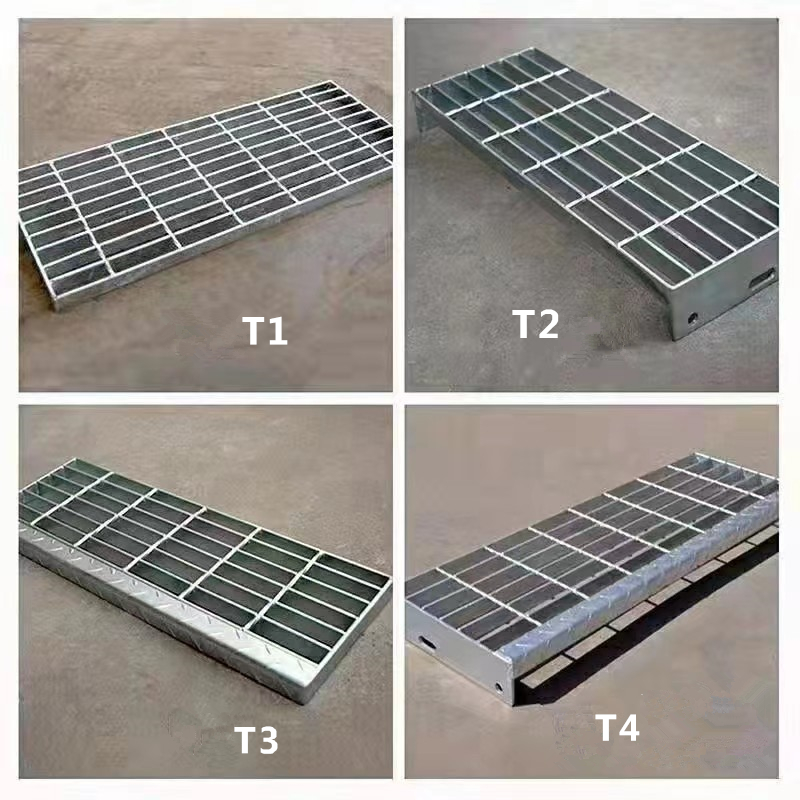
Structure:
Characteristics:
Application:
Installation Difficulty:
Engineering Note:
Without nosing, edge traction is limited. This type is typically used where surface conditions remain dry and controlled.
Structure:
Characteristics:
Application:
Installation Difficulty:
Engineering Note:
T2 improves installation flexibility but does not address slip risk at the step edge.
Structure:
Characteristics:
Application:
Installation Difficulty:
Engineering Note:
The addition of nosing significantly improves slip resistance at the most critical contact zone of the step.
Structure:
Characteristics:
Application:
Installation Difficulty:
Engineering Note:
T4 is the most balanced option, offering both installation efficiency and enhanced safety performance. It is widely specified in projects where both factors are critical.
| Type | Fixing Method | Nosing | Installation Speed | Slip Resistance | Typical Use |
| T1 | Welded | No | Medium | Low | Indoor controlled areas |
| T2 | Bolted | No | Fast | Low | Retrofit / maintenance access |
| T3 | Welded | Yes | Slow | High | Industrial outdoor stairs |
| T4 | Bolted | Yes | Fast | High | Fire escape / high-safety zones |
These grating stair tread are used in:
Because each tread is prefabricated:
For projects requiring consistent flooring performance, stair treads are typically installed together with
→ [metal floor grating]
to maintain uniform load behavior across platforms and stairs.
As a
→ Industrial Bar Grating factory
we supply fully finished ready-to-install stair treads, not semi-processed parts.
This means installers can complete stair assembly without rework or adjustment.
If your project involves:
Provide:
We will supply prefabricated grating stair treads matched to your project conditions.
Q1:What information should I provide for a Grating Stair Treads quotation?
A:Please provide the tread width, tread depth, length, bearing bar size, mesh size, fixing method, nosing type, surface finish, quantity, and application. If you have stair drawings or stringer dimensions, we can confirm the correct end plate design and recommend a suitable tread type.
Q2:Can grating stair treads be customized according to project drawings?
A:Yes. Grating stair treads can be customized by length, depth, bearing bar size, mesh opening, nosing style, end plate type, and surface treatment. Custom fabrication helps ensure each tread fits the stair stringer correctly and reduces cutting or adjustment work during installation.
Q3:What is the difference between T1, T2, T3, and T4 stair treads?
A:The main differences are fixing method and nosing design. T1 is welded without nosing, T2 is bolted without nosing, T3 is welded with checker plate nosing, and T4 is bolted with checker plate nosing. T4 is often selected when both fast installation and better slip resistance are required.
Q4:When should I choose bolt-on stair treads instead of welded treads?
A:Bolt-on stair treads are recommended for retrofit projects, maintenance platforms, operating facilities, or sites where welding is restricted. They are easier to install, remove, and replace. Welded treads are suitable for permanent structures where higher rigidity and fixed installation are preferred.
Q5:Are anti-slip stair treads necessary for outdoor stairs?
A:Anti-slip stair treads are strongly recommended for outdoor stairs, fire escape systems, wet areas, and industrial access routes. Checker plate or ribbed nosing improves traction at the front edge of the step, where slipping is most likely to occur during walking.
Q6:What tread depth is commonly used for industrial stair treads?
A:Common tread depths include 240 mm, 270 mm, and 300 mm. The right depth depends on stair design, walking comfort, safety requirements, and local project standards. For industrial stairs, the tread depth should also match the stringer layout and expected foot traffic.
Q7:What materials are available for steel stair treads?
A:Steel stair treads are commonly made from carbon steel or stainless steel. Carbon steel with hot-dip galvanizing is widely used for industrial stairs because it offers good strength and corrosion resistance. Stainless steel is suitable for corrosive, hygienic, or special architectural environments.
Q8:Can galvanized stair treads be used in outdoor or corrosive environments?
A:Yes. Galvanized stair treads are suitable for outdoor stairs, industrial plants, ports, fire escapes, and maintenance platforms. Hot-dip galvanizing helps protect the surface, edges, and connection areas from corrosion, especially where moisture, weather exposure, or abrasion may shorten service life.
Q9:How do I choose between checker plate nosing and ribbed nosing?
A:Checker plate nosing is commonly used for industrial stairs where stronger edge traction and visibility are needed. Ribbed nosing can also improve grip and provide a clean front-edge design. The final choice depends on safety requirements, appearance preference, working environment, and project specifications.
Q10:How is dimensional accuracy controlled before shipment?
A:Dimensional inspection includes checking tread length, depth, bearing bar size, mesh spacing, end plate position, bolt hole accuracy, diagonal tolerance, and nosing alignment. This helps ensure the stair treads fit the steel stringers properly and reduces installation errors on site.
Q11:Can prefabricated stair treads reduce installation time?
A:Yes. Prefabricated stair treads are supplied as ready-to-install units with fixed geometry, end plates, and optional nosing. This reduces on-site cutting, welding, alignment work, and installation errors. They are especially useful for modular stair systems, retrofit projects, and projects with tight installation schedules.
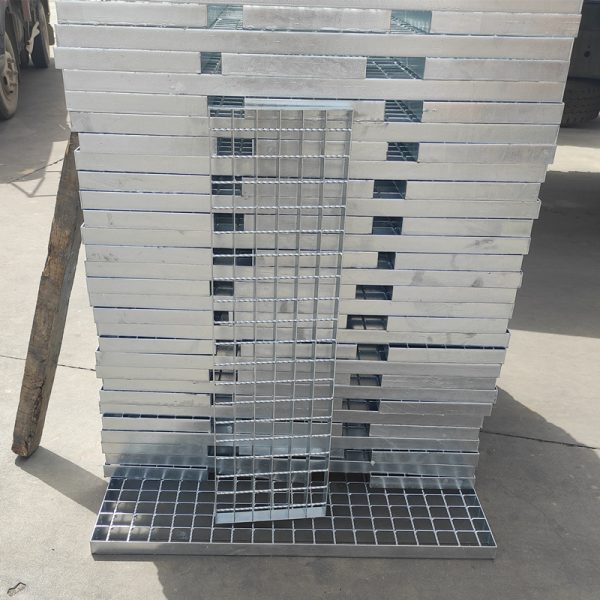
Q12:How are Grating Stair Treads packed for export shipping?
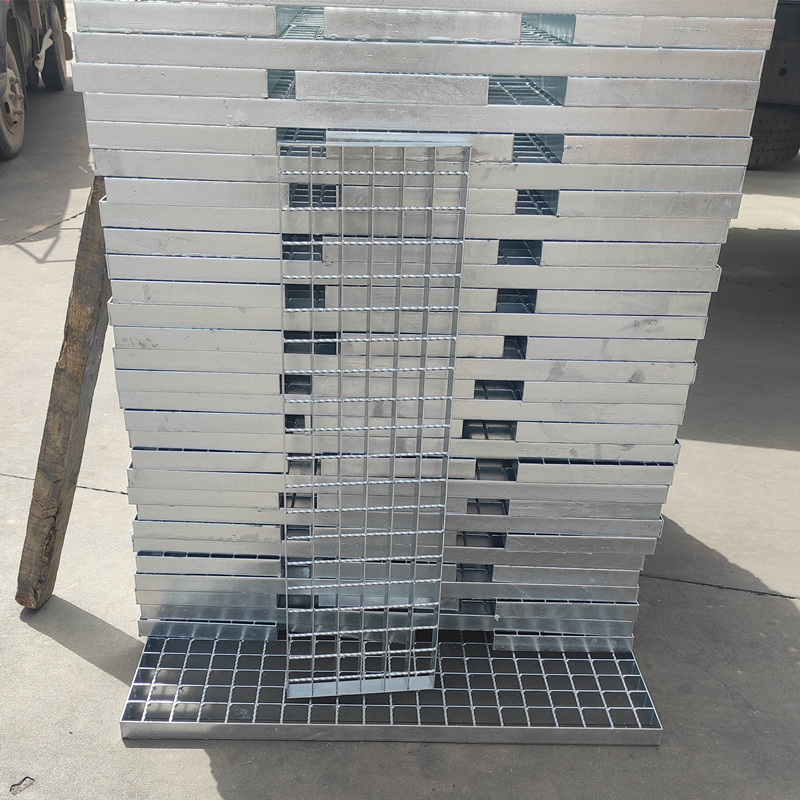
A:Grating Stair Treads are usually packed in reinforced bundles with edge protection and export-ready packaging to reduce deformation, coating damage, and impact during transportation. For project orders, packaging can be adjusted according to tread size, quantity, container loading plan, and destination requirements.
See how our industrial stair treads are manufactured, installed, and tested for safety.
Designed as prefabricated anti-slip stair treads, they are ideal for towers, platforms, and fire escapes.
Steel Grating Stair Treads Overview | Ready-to-Install Steps
Get a quick look at our bolt-on stair treads with nosing design for enhanced safety and easy installation.
See how our anti-slip stair treads perform under real load and high-traffic conditions, ensuring long-term safety.

Factory workshop
Serrated Bar Grating Stair Treads

Grating Stair Treads Products – Hot-Dip Galvanized

Galvanized Steel Grating Packaging for Export

Standard Packaging of Galvanized Steel Grating
Send us your dimensions and load requirements for a fast quote.