








Why Steel Bar Grating Is Widely Used in Factory Platforms
Factory platforms are exposed to constant foot traffic, equipment movement, moisture, chemicals, and heavy industrial loads. Choosing the correct steel bar grating for factory platforms is not only about price — it directly affects worker safety, maintenance costs, and long-term structural performance.
In industrial plants, manufacturing workshops, warehouses, power stations, and chemical facilities, steel bar grating is commonly used for:
- Elevated work platforms
- Maintenance walkways
- Mezzanine flooring
- Equipment access areas
- Drainage covers around machinery
- Offshore and heavy-duty industrial flooring
A properly selected grating system improves ventilation, drainage, anti-slip performance, and load distribution while reducing overall platform dead weight compared to solid steel plates.
However, not all grating specifications are suitable for every project. Buyers should evaluate load requirements, surface type, finish protection, and fabrication details before placing an order.
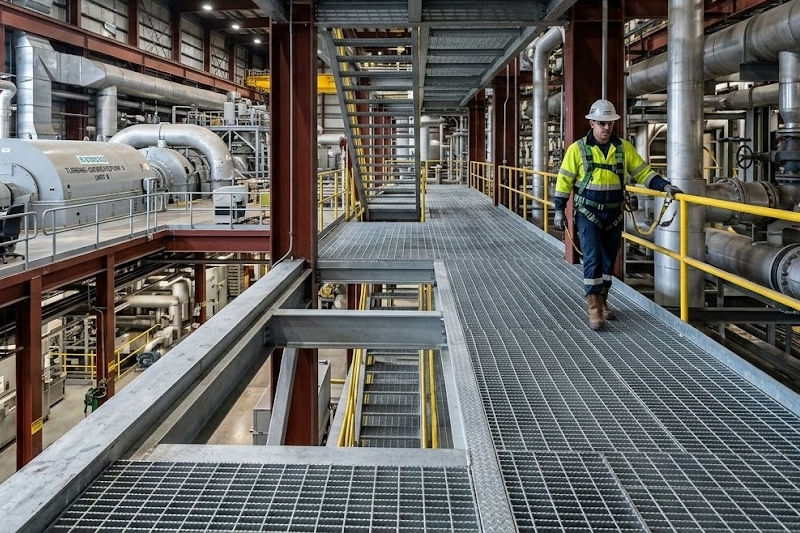
Understanding Platform Load Requirements
The first step in choosing steel bar grating for factory platforms is determining the expected load conditions.
Different industrial environments require different bearing capacities. A light-duty maintenance walkway and a forklift-access platform will require completely different grating specifications.
Common Load Considerations
Before selecting the grating type, engineers and buyers should confirm:
- Uniform distributed load
- Concentrated load points
- Equipment weight
- Foot traffic frequency
- Vehicle or trolley movement
- Span direction and support spacing
In many factory projects, the span between support beams directly affects the required bearing bar size. Longer spans generally require deeper and thicker bearing bars to prevent deflection.
For example:
| Application | Recommended Grating Type |
|---|---|
| Light-duty maintenance platform | 25×3 mm bearing bar |
| Standard factory walkway | 30×3 mm bearing bar |
| Heavy industrial platform | 40×5 mm or larger |
| Forklift traffic area | Customized heavy-duty grating |
Selecting undersized grating may reduce initial purchase cost, but it often leads to excessive bending, vibration, or structural failure over time.
Professional steel grating manufacturers usually provide load tables to help buyers match the correct specification with the required span and load capacity.
Choosing Between Plain and Serrated Steel Bar Grating
Surface safety is another critical factor in factory platform design.
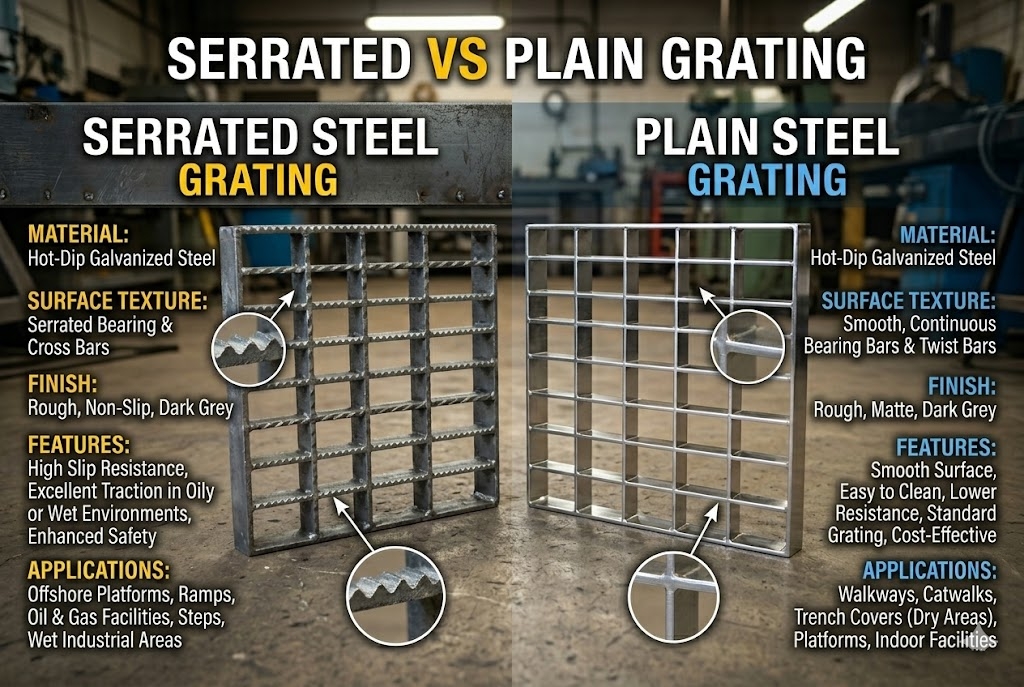
The two most common surface styles are:
Plain Steel Bar Grating
Plain grating has a smooth top surface and is widely used in:
- Dry indoor factory environments
- Equipment platforms
- Mechanical rooms
- General industrial flooring
Advantages include:
- Easier cleaning
- Lower production cost
- Comfortable walking surface
- Suitable for most indoor applications
However, plain grating may become slippery in oily or wet environments.
Serrated Steel Bar Grating
Serrated grating features anti-slip teeth cut into the top edge of the bearing bars.
This type is strongly recommended for:
- Oil and gas facilities
- Chemical plants
- Outdoor platforms
- Wastewater treatment plants
- Food processing factories
- Areas exposed to rain, oil, or ice
The serrated surface significantly improves traction and worker safety, especially in demanding industrial conditions.
Although serrated grating is slightly more expensive than plain grating, many industrial buyers consider the additional safety benefit worth the investment.
For factory platforms exposed to moisture or lubricants, serrated steel bar grating is often the preferred long-term solution.
Why Hot-Dip Galvanized Finish Matters
Corrosion protection is one of the biggest concerns in industrial platform projects.
Carbon steel grating without proper surface treatment can quickly rust in humid or chemically aggressive environments.
That is why hot-dip galvanized steel bar grating remains the industry standard for factory platforms.
Benefits of Hot-Dip Galvanizing
Hot-dip galvanizing creates a protective zinc coating over the steel surface, helping extend service life and reduce maintenance costs.
Main advantages include:
- Excellent corrosion resistance
- Long outdoor service life
- Lower maintenance frequency
- Better protection in humid factories
- Improved durability in chemical environments
In many industrial projects, galvanized steel grating can last for decades with minimal maintenance.
For indoor dry environments, some buyers may choose painted steel grating as a lower-cost alternative. However, galvanized grating generally provides better long-term value for industrial facilities.
Important Specification Details Buyers Should Confirm
Many overseas buyers focus only on grating size and price, but incomplete technical information often causes quotation delays or manufacturing errors.
To receive an accurate quotation for steel bar grating for factory platforms, buyers should prepare a complete specification checklist.
Essential Quotation Information
A professional inquiry should include:
Grating Dimensions
- Length and width of each panel
- Total quantity required
Bearing Bar Specification
- Bearing bar size
- Bearing bar spacing
- Cross bar spacing
Surface Type
- Plain
- Serrated
Surface Treatment
- Hot-dip galvanized
- Painted
- Untreated black steel
- Stainless steel
Load Requirement
- Pedestrian traffic
- Equipment load
- Vehicle traffic if applicable
Installation Details
- Support beam spacing
- Installation clips requirement
- Edge banding requirement
Drawings or Layouts
Providing CAD drawings or platform layouts can greatly improve quotation accuracy and reduce communication time.
Galvanized Carbon Steel vs Stainless Steel Grating
Some industrial buyers also compare galvanized carbon steel grating with stainless steel grating.
Galvanized Carbon Steel Grating
Best for:
- General factory platforms
- Warehouses
- Power plants
- Industrial workshops
Advantages:
- Lower cost
- Strong structural performance
- Widely available
- Cost-effective for large projects
Stainless Steel Grating
Best for:
- Food processing plants
- Pharmaceutical facilities
- Marine environments
- Highly corrosive applications
Advantages:
- Superior corrosion resistance
- Attractive appearance
- Longer lifespan in extreme environments
However, stainless steel grating is significantly more expensive, so it is usually reserved for specialized industrial applications.
Working With an Experienced Steel Grating Supplier
Factory platform projects often involve custom fabrication, project schedules, export packaging, and engineering coordination.
An experienced steel grating supplier can help buyers:
- Select the correct specification
- Optimize grating layout
- Reduce material waste
- Improve installation efficiency
- Meet international standards
- Control project cost
For overseas industrial buyers, choosing a supplier with export experience is especially important for avoiding production misunderstandings and shipping delays.
Final Thoughts
Choosing the right steel bar grating for factory platforms requires more than simply comparing prices.
Load capacity, anti-slip safety, corrosion resistance, platform environment, and fabrication details all play important roles in long-term project performance.
For most industrial factory platforms, hot-dip galvanized steel bar grating offers an excellent balance of strength, durability, safety, and cost efficiency.
Before placing an order, buyers should carefully confirm platform load requirements, select the proper surface type, and provide complete technical specifications to ensure accurate manufacturing and reliable installation results.


