









Introduction: Understanding the Two Main Grating Types
In industrial flooring systems, both welded steel grating and press locked grating are widely used, but they serve slightly different engineering priorities. The debate around welded steel grating vs press locked grating usually comes down to strength, manufacturing method, cost efficiency, and application environment.
For engineers, contractors, and procurement teams, choosing the right type directly impacts structural performance, installation efficiency, and long-term maintenance costs.
Manufacturing Differences
Welded Steel Grating
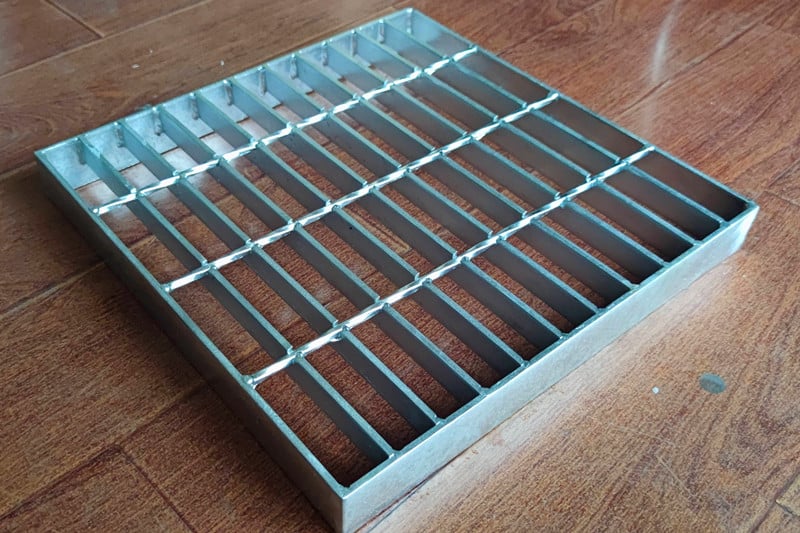
Welded steel grating is manufactured by resistance welding bearing bars and cross bars at every intersection. This creates a rigid, monolithic panel structure with high torsional stability. The weld points are permanent, making the panel highly resistant to loosening under repeated load cycles.
Press Locked Grating

Press locked grating is manufactured using flat steel strips for both bearing bars and cross bars. Both components are first precision-slotted and then interlocked at their intersections. At selected contact points, they are secured by spot welding or fillet welding, which concentrates heat in a very small area and helps minimize overall thermal distortion during fabrication.The final result is a structurally stable grating with uniform load distribution and a clean, visually consistent grid pattern.
From a production standpoint, welded steel grating is generally faster to manufacture in high volumes, while press locked systems may require more precise alignment during assembly.
Cost and Lead Time Comparison
When evaluating welded steel grating vs press locked grating, cost structure plays a significant role.
Welded steel grating typically offers:
- Lower unit cost for standard industrial sizes
- Faster mass production cycles
- Reduced fabrication complexity
Press locked grating, on the other hand, may involve:
- Higher manufacturing precision requirements
- Slightly longer production time for customized specifications
- Increased labor involvement depending on design complexity
For large-scale industrial flooring projects, welded steel grating often provides better cost efficiency and shorter lead times.
Load Performance and Structural Behavior
Welded Steel Grating Strength Profile
Welded steel grating is widely recognized for its high load-bearing capacity. The welded joints ensure force distribution across both bearing and cross bars, making it suitable for heavy-duty industrial floors, platforms, and trench covers.
Press Locked Grating Performance
Press locked grating performs well under moderate loads. Its interlocked structure provides good rigidity, but under extreme dynamic or point loading, it may not perform as consistently as welded systems.
In heavy industrial environments—such as petrochemical plants, steel mills, and logistics centers—welded steel grating is generally preferred due to its predictable load response.
Vibration Resistance and Stability
Vibration resistance is a critical factor in industrial floor design, especially in environments with moving machinery or heavy transport equipment.
Welded steel grating offers superior vibration resistance because its welded joints prevent micro-movement between bars. This reduces noise, fatigue stress, and long-term deformation.
Press locked grating, while stable under static loads, may experience slight micro-shifts over extended periods in high-vibration environments.
For platforms requiring enhanced stability, engineers often combine welded systems with additional framing or select reinforced configurations.
Best Applications for Each Type
Welded Steel Grating Applications
Welded steel grating is ideal for:
- Heavy-duty industrial platforms
- Walkways in manufacturing plants
- Petrochemical facilities
- Truck loading docks
- Power plants and utility structures
In many cases, it is also used as a base for industrial floor mesh systems where durability is a primary requirement.
Press Locked Grating Applications
Press locked grating is commonly used in:
- Architectural facades
- Light to medium-duty walkways
- Drainage covers in urban environments
- Decorative industrial structures
It is often selected when aesthetics and moderate load performance are both important.
Practical Engineering Insight
In real-world procurement decisions, the choice between welded steel grating vs press locked grating is rarely purely technical. It often involves balancing:
- Structural requirements
- Budget constraints
- Installation speed
- Long-term maintenance expectations
For heavy industrial use, welded systems are typically the default engineering choice. For architectural or light-duty applications, press locked designs may offer better visual integration and sufficient performance.
Conclusion
The comparison of welded steel grating vs press locked grating shows that both systems have clear engineering roles. Welded steel grating dominates in strength, vibration resistance, and heavy-load environments, while press locked grating offers flexibility and aesthetic advantages for lighter applications.
Selecting the right system depends on understanding load conditions, project lifecycle expectations, and installation constraints.


