









Metal Bar Grating vs FRP Grating: How to Choose for Safer Industrial Platforms
When specifying materials for industrial platforms, walkways, or elevated structures, engineers and procurement teams often face a familiar question: metal bar grating vs FRP grating—which is the better choice?
The answer depends on more than just price. Load capacity, fire safety, environmental exposure, and lifecycle cost all play critical roles in selecting the right grating system. Based on years of field applications across manufacturing plants, chemical facilities, and infrastructure projects, this guide breaks down the key differences that matter in real-world decision-making.
Strength Comparison: Load Capacity and Structural Reliability
Metal Bar Grating: Proven Structural Performance
Metal bar grating is widely recognized for its superior load-bearing capacity. Manufactured through welding or pressure-locking processes, it delivers high strength-to-weight efficiency and excellent rigidity under dynamic loads.
In heavy-duty environments—such as oil & gas platforms, industrial flooring, or logistics centers—metal bar grating maintains structural integrity even under concentrated loads and continuous traffic.
FRP Grating: Lightweight but Limited Load Range
Fiberglass Reinforced Plastic (FRP) grating offers a lightweight alternative, typically easier to handle and install. However, its load capacity is inherently lower compared to steel.
While FRP performs adequately in pedestrian walkways or light-duty applications, it may experience deflection or long-term fatigue when subjected to heavy equipment or repeated mechanical stress.
Key Insight:
For high-load industrial platforms, steel bar grating remains the more reliable choice in terms of structural safety and longevity.
Fire Resistance: A Critical Safety Factor
Steel Grating: Non-Combustible and Fire-Stable

Steel is inherently non-combustible, making metal bar grating the preferred option in facilities where fire safety is a regulatory requirement. It does not contribute to flame spread and retains structural integrity under high temperatures.
This is particularly important in industries such as petrochemical processing, power generation, and offshore operations.
FRP Grating: Flame Retardant but Not Fireproof

FRP grating can be manufactured with flame-retardant resins. However, under extreme heat, it can soften, deform, or emit smoke and toxic fumes.
Even with fire-retardant additives, FRP does not match the fire performance of steel.
Key Insight:
In fire-sensitive environments, metal bar grating provides a significantly higher safety margin.
Corrosion Resistance: Matching Material to Environment
FRP Grating: Excellent Chemical Resistance
One of FRP’s strongest advantages is its resistance to corrosion. It performs exceptionally well in highly corrosive environments, including:
- Chemical processing plants
- Wastewater treatment facilities
- Coastal or marine environments
FRP does not rust and requires minimal protective treatment.
Steel Grating: Corrosion Protection Through Treatment
Steel bar grating can also perform well in corrosive environments when properly treated. Common options include:
- Hot-dip galvanizing
- Powder coating
- Stainless steel fabrication

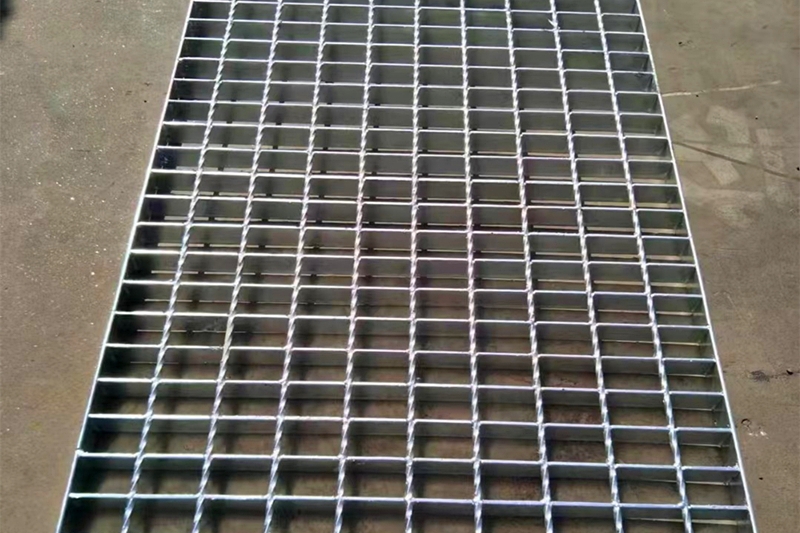
Galvanized steel grating, in particular, offers long-term corrosion resistance in outdoor and industrial settings.
Key Insight:
FRP is ideal for highly corrosive conditions, while galvanized or stainless steel grating provides a balanced solution for most industrial environments.
Long-Term Maintenance and Replacement Cost
Steel Grating: Lower Lifecycle Cost
Although the initial cost of steel bar grating may be higher than FRP in some cases, its durability often results in lower long-term expenses.
Steel grating typically requires:
- Minimal maintenance
- Long service life (often decades)
- High resistance to wear and impact
This makes it a cost-effective solution over the lifecycle of a project.
FRP Grating: Lower Upfront Cost, Higher Replacement Frequency
FRP grating may offer lower upfront material and installation costs. However, it can be more susceptible to:
- UV degradation over time
- Surface wear
- Structural fatigue in heavy-duty applications
This may lead to more frequent replacement, increasing total ownership cost.
Key Insight:
When evaluating total cost of ownership, metal bar grating often delivers better long-term value.
Final Decision: Which Grating Is Right for Your Project?
Choosing between metal bar grating vs FRP grating ultimately depends on your specific application requirements.
Choose Metal Bar Grating if you need:
- High load-bearing capacity
- Fire resistance and safety compliance
- Long-term durability with minimal maintenance
Choose FRP Grating if you need:
- Superior corrosion resistance
- Lightweight installation
- Non-conductive material properties
In many industrial projects, steel bar grating remains the default choice due to its proven strength, safety performance, and lifecycle efficiency. However, FRP grating serves as a valuable alternative in niche environments where corrosion resistance is the top priority.


