









Understanding Steel Bar Grating Bearing Bar Size in Heavy Load Applications
When specifying steel bar grating for industrial or infrastructure projects, one of the most critical parameters is the bearing bar size. For engineers, contractors, and procurement teams, selecting the correct steel bar grating bearing bar size is not just a design decision—it directly impacts structural safety, service life, and total lifecycle cost.
In heavy load environments such as truck terminals, port facilities, and manufacturing plants, undersized bearing bars can lead to deformation, excessive deflection, or even structural failure. On the other hand, over-specifying increases cost unnecessarily. The key is balance—engineering precision combined with real-world application insight.
Bearing Bar Height and Thickness: The Core Load Factors
The bearing bar is the primary load-carrying component of steel grating. Its height (depth) and thickness determine how much load the grating can safely support.
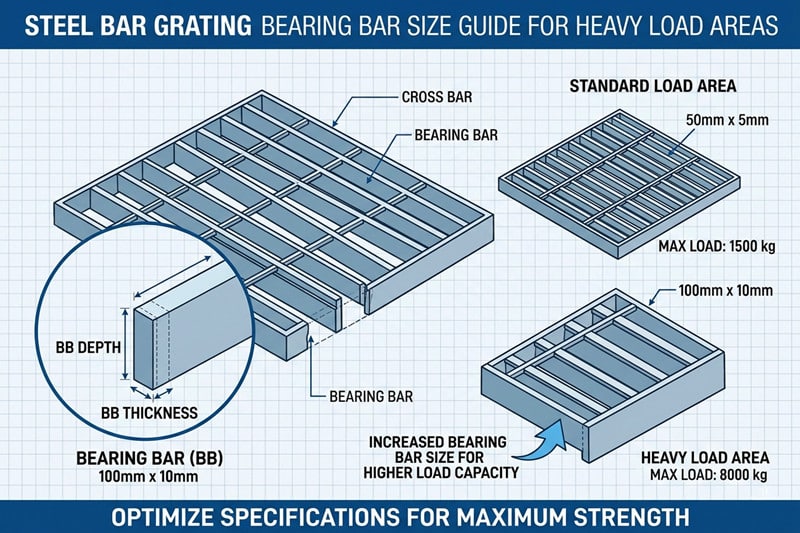
Why Height Matters More Than Thickness
In structural mechanics, the load capacity of a bar increases exponentially with its height. This means:
- Increasing bar height significantly improves load-bearing capacity
- Increasing thickness provides additional strength but with less impact compared to height
For example (based on common Chinese standard production practices):
- 30 mm height → suitable for pedestrian or light-duty areas
- 40–50 mm height → medium-duty industrial flooring
- 60 mm and above → heavy-duty applications such as truck traffic or equipment zones
Thickness (typically 3 mm, 5 mm, or 6 mm) adds rigidity and resistance to localized stress but is usually adjusted after height is determined.
Practical Engineering Insight
From years of manufacturing and export experience, most heavy-load projects prioritize higher bearing bars (≥50 mm) combined with thicker flat bars (≥5 mm) to ensure both strength and durability under repeated loading cycles.
Span Impact: Why Distance Changes Everything
Even with the same bearing bar size, span (the distance between supports) can drastically change performance.
The Relationship Between Span and Load Capacity
- Shorter span → higher load capacity
- Longer span → increased deflection and stress
For example:
- A 40×5 mm bearing bar may perform well at a 500 mm span
- The same bar may fail or deform at a 1000 mm span under identical load conditions
Engineering Recommendation
Always define span before confirming bearing bar size. In many export projects, we see issues arise because buyers request a standard size without clearly specifying support spacing.
For heavy-duty areas, reducing span is often more cost-effective than increasing bar size excessively.
Heavy Equipment Areas: Special Design Considerations
Not all heavy loads are equal. Static loads and dynamic loads behave very differently in real applications.

Common Heavy Load Scenarios
- Forklift traffic in warehouses
- Truck loading zones
- Container yards and port platforms
- Steel plant or machinery maintenance platforms
Key Factors to Evaluate
- Load type
- Static (equipment sitting)
- Dynamic (vehicles moving)
- Wheel load vs distributed load
Concentrated wheel loads require stronger grating compared to evenly distributed loads - Impact and fatigue
Repeated movement (e.g., forklifts) can cause long-term fatigue even if initial load capacity is sufficient
Industry Practice
For these applications, engineers typically select:
- Higher bearing bars (50–75 mm)
- Thicker bars (5–6 mm)
- Smaller spacing between bearing bars (according to Chinese standards such as 30 mm or 40 mm pitch)
This combination ensures safety, longevity, and compliance with industrial usage expectations.
What Buyers Should Provide for Accurate Quotation
One of the most common challenges in international B2B projects is incomplete technical information during the inquiry stage. Without key parameters, suppliers can only provide rough estimates, which often leads to redesign, delays, or cost adjustments.
Essential Data for Quotation
To recommend the correct steel bar grating bearing bar size, suppliers typically require:
- Application scenario (walkway, trench cover, heavy vehicle area, etc.)
- Maximum load requirement (kN/m² or wheel load)
- Span (support distance)
- Panel size (length × width)
- Installation method (welded, bolted, removable)
- Surface treatment (galvanized, painted, stainless steel)
Why This Matters
Providing complete data allows manufacturers to:
- Calculate accurate load performance
- Optimize material usage
- Ensure compliance with project safety standards
- Avoid overdesign or underdesign
From a procurement perspective, this reduces risk and ensures that what you receive matches your actual working conditions.
Final Thoughts: Balancing Safety, Cost, and Performance
Selecting the right steel bar grating bearing bar size is not about choosing the biggest specification—it’s about choosing the right one based on engineering logic and application realities.
For heavy load areas, always prioritize:
- Correct bearing bar height
- Appropriate thickness
- Realistic span conditions
- Accurate load data
If you’re unsure, working with an experienced manufacturer who understands both Chinese production standards and international project requirements can make a significant difference in both safety and cost efficiency.






