








What Deflection Means in Steel Bar Grating Applications
In industrial flooring systems, deflection refers to how much a steel bar grating panel bends under load. While some level of deflection is expected in any load-bearing structure, excessive movement can compromise both safety and performance.

For engineers and project buyers, understanding steel bar grating deflection limits is not just a design detail—it directly affects worker safety, equipment stability, and long-term durability. In high-traffic environments such as manufacturing plants, mezzanines, and trench covers, even minor miscalculations can lead to noticeable flexing, vibration, or premature failure.
From field experience, excessive deflection is often first noticed not as structural failure, but as “bounce” under foot traffic or visible sag under rolling loads. These are early warning signs that the grating specification may not meet actual service conditions.
L/200 and L/300: The Industry Baseline
When specifying steel bar grating, deflection limits are typically expressed as a ratio of span length (L). The most common steel bar grating standards used in engineering practice are:
L/200 – General Industrial Standard
An L/200 deflection limit means the maximum allowable deflection is the span divided by 200.
- Suitable for most standard industrial flooring
- Acceptable for foot traffic and light equipment
- Balances cost efficiency with structural performance
L/300 – Enhanced Safety and Comfort
An L/300 limit is more stringent, reducing allowable deflection by 33% compared to L/200.
- Recommended for high-traffic walkways
- Ideal where vibration control is important
- Often specified in platforms with sensitive equipment or frequent personnel movement
In real-world projects, many engineers default to L/200 for budget reasons, but upgrade to L/300 when user comfort or perceived safety becomes a priority.
The Hidden Risks of Undersized Grating
Choosing grating based solely on load capacity—without considering deflection—can create operational risks that are often underestimated.
Safety Concerns
Excessive deflection can lead to:
- Worker discomfort or hesitation when walking
- Increased slip or trip hazards
- Reduced confidence in elevated platforms
Structural Fatigue
Repeated bending under load accelerates fatigue in bearing bars and weld joints. Over time, this may result in:
- Cracking at load points
- Permanent deformation
- Reduced service life
Equipment Impact
For facilities using carts, forklifts, or wheeled equipment:
- Deflection can disrupt smooth movement
- Causes uneven load distribution
- Increases wear on both grating and machinery
In several retrofit projects we’ve seen, the original issue wasn’t insufficient load rating—it was excessive deflection that made the system feel unstable long before any actual failure occurred.
What Engineers Should Verify Before Specification
To ensure compliance with steel bar grating deflection limits, engineers and procurement teams should validate several key parameters:
1. Clear Span vs. Support Conditions
Deflection calculations depend heavily on actual span length—not nominal panel size. Confirm:
- Support spacing (center-to-center)
- Edge conditions (simple support vs. fixed)
2. Load Type and Distribution
Different loads produce different deflection responses:
- Uniform loads (personnel, stored materials)
- Concentrated loads (equipment wheels, point loads)
Always verify worst-case scenarios rather than average conditions.
3. Bearing Bar Size and Spacing
Deflection is directly influenced by:
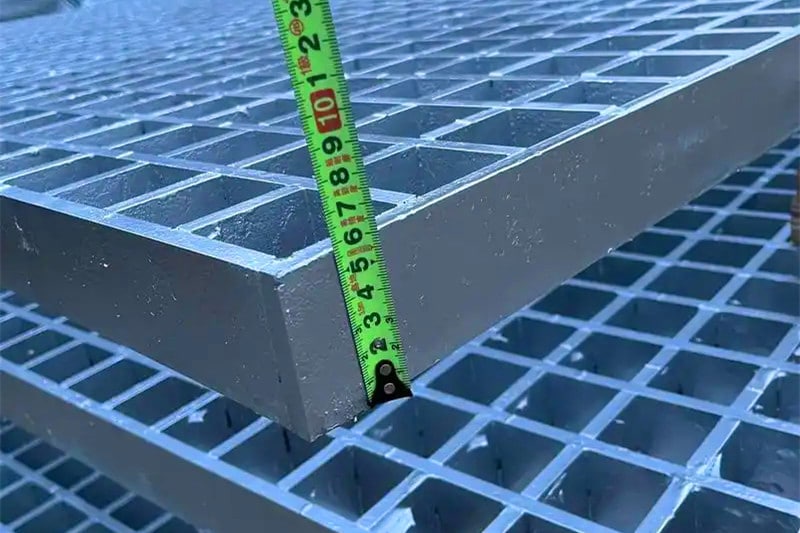
- Bearing bar height (strongest factor)
- Thickness and spacing
- Steel grade
A small increase in bar height often results in a significant reduction in deflection.
4. Compliance with Standards
Ensure alignment with recognized standards such as:
- ANSI/NAAMM (North America)
- BS or ISO equivalents for international projects
These standards provide validated tables for load and deflection performance.
Practical Recommendation from Field Experience
If your project involves elevated platforms, frequent pedestrian traffic, or rolling loads, specifying L/300 instead of L/200 is often a low-cost upgrade with high long-term value.
For export-oriented or safety-critical projects, clearly communicating deflection requirements to your supplier avoids mismatches between design intent and delivered product. Many issues arise not from manufacturing defects, but from incomplete technical communication during procurement.
Final Thoughts
Deflection is one of the most overlooked yet critical factors in steel bar grating design. While load capacity ensures structural survival, deflection limits determine usability, safety perception, and lifecycle performance.
By prioritizing appropriate steel bar grating deflection limits, engineers and buyers can prevent costly retrofits, improve user confidence, and ensure that industrial flooring performs as intended over time.