








Understanding Slip Hazards in Industrial Environments
In many industrial settings—such as wastewater treatment plants, food processing facilities, offshore platforms, and chemical plants—floor safety is not optional. Wet, oily, or chemical-exposed surfaces significantly increase the risk of slips and falls, which are among the most common causes of workplace injuries.
Steel bar grating is widely used in these environments because of its strength, drainage capability, and ventilation properties. However, not all grating surfaces perform equally when it comes to slip resistance. The choice between plain and serrated steel bar grating directly impacts worker safety, compliance, and operational reliability.
Plain Steel Bar Grating: Where It Works Best

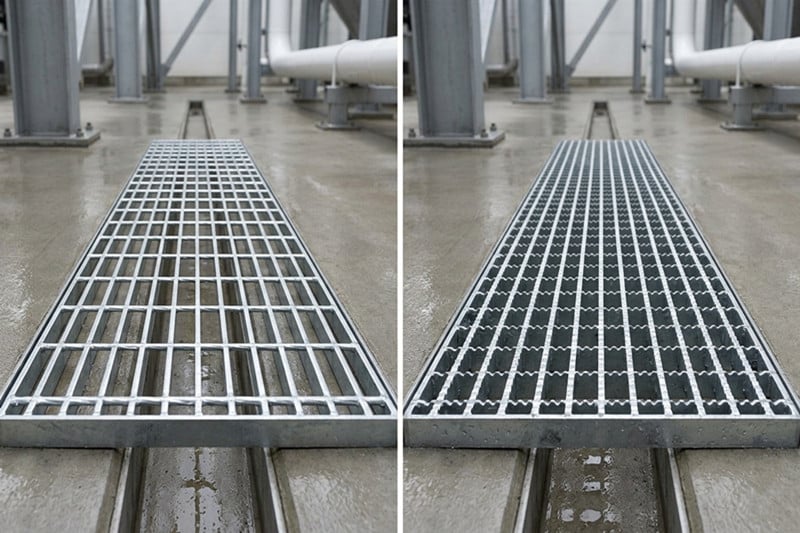
Plain steel bar grating features a smooth, flat surface on the load-bearing bars. It is commonly selected for applications where:
- Foot traffic is light or controlled
- Surfaces remain mostly dry
- Cost efficiency is a priority
- Easy cleaning is required (e.g., indoor mechanical rooms)
From a manufacturing perspective, plain grating is simpler to produce, which often translates to shorter lead times and lower costs. However, in wet or oily environments, its smooth surface provides limited traction, especially when combined with contaminants like grease or algae.
For low-risk areas, plain grating remains a practical solution—but it is not typically recommended where slip hazards are a known concern.
Serrated Steel Bar Grating: Designed for Safety
Serrated steel bar grating is engineered with notched edges along the top of the load-bearing bars. These serrations create additional friction underfoot, significantly improving grip in challenging conditions.

Key Benefits of Serrated Steel Bar Grating
- Enhanced slip resistance: The jagged surface increases traction even when wet or oily
- Improved worker safety: Reduces the likelihood of accidents in high-risk zones
- Reliable performance in harsh conditions: Effective in rain, ice, grease, and chemical exposure
- Compliance support: Helps meet safety standards in industries with strict regulations
In environments where safety is critical, serrated grating is often considered the default specification rather than an upgrade.
Wet and Oily Surfaces: Why Surface Type Matters
When liquids accumulate on walking surfaces, they act as a lubricant between footwear and the grating surface. This reduces friction and increases the probability of slipping.
Serrated steel bar grating addresses this issue by:
- Breaking the surface tension of liquids
- Providing multiple contact points for footwear
- Allowing contaminants to drain while maintaining grip
In contrast, plain grating relies solely on friction from a flat surface, which can be insufficient under these conditions.
For industries such as oil & gas, marine, and food processing, where oils, water, and residues are unavoidable, serrated grating offers a measurable safety advantage.
How to Choose the Right Grating for Your Workplace
Selecting between plain and serrated steel bar grating should be based on a risk-based assessment rather than cost alone. Consider the following factors:
1. Environmental Conditions
- Wet, oily, or chemical exposure → Serrated grating recommended
- Dry, controlled environments → Plain grating may suffice
2. Traffic Type
- Frequent pedestrian traffic → Serrated improves safety
- Equipment-only access → Plain may be acceptable
3. Safety Regulations
- Industries with strict OSHA or equivalent standards often favor serrated surfaces
4. Maintenance and Cleaning
- Serrated surfaces may require slightly more effort to clean but provide long-term safety benefits
5. Lifecycle Cost vs Initial Cost
While serrated steel bar grating may have a higher upfront cost, it often reduces accident-related expenses and downtime over time.
Market Insight: Why More Buyers Are Choosing Serrated Options
From a B2B procurement perspective, there has been a noticeable shift toward safety-first specifications. Engineering firms, EPC contractors, and facility managers increasingly prioritize materials that minimize liability and improve workplace safety metrics.
As a result, serrated steel bar grating is becoming the preferred choice in project specifications, especially for export markets where compliance and safety documentation are critical.
Final Thoughts
Choosing between plain and serrated steel bar grating is not just a technical decision—it’s a safety strategy.
If your project involves wet, slippery, or high-risk environments, investing in serrated steel bar grating is a practical and responsible choice. For low-risk, dry applications, plain grating remains a cost-effective solution.
Ultimately, aligning your selection with real-world working conditions ensures both operational efficiency and long-term safety performance.


