









Understanding Welded vs Press Locked Steel Bar Grating
When engineers and procurement teams compare welded vs press locked steel grating, the decision typically comes down to application requirements, load conditions, and aesthetic expectations. Both types are widely used across industrial platforms, walkways, mezzanines, and drainage covers—but they serve slightly different priorities.
From years of supplying grating to global contractors, one thing is clear: choosing the right type early can reduce lifecycle cost, simplify installation, and avoid overengineering.
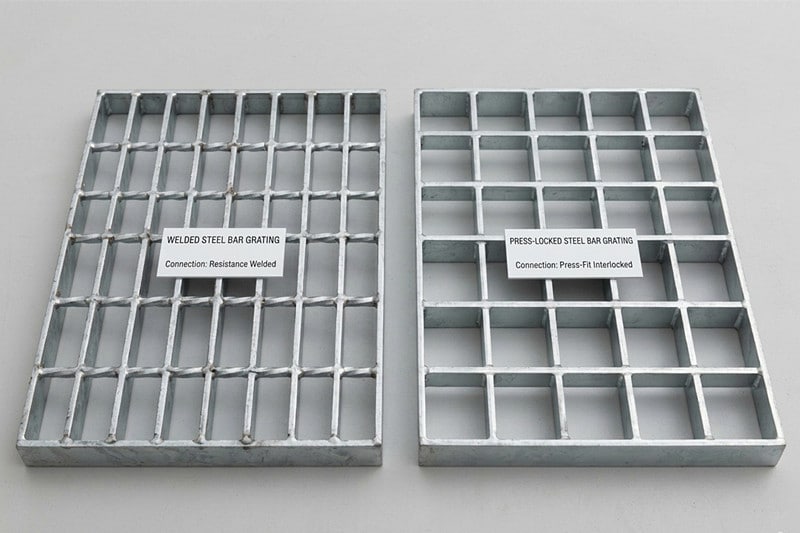
Manufacturing Differences: How Each Type Is Made
Welded Steel Bar Grating
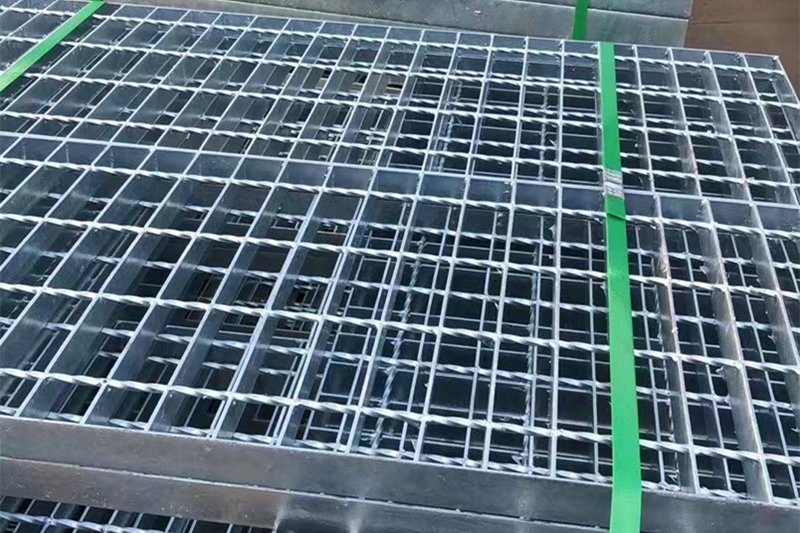
Welded Steel Grating is produced through an automated resistance-welding process. Bearing bars and cross bars are fused under high pressure and temperature, forming a permanent joint.
- High-speed, automated production
- Consistent weld strength at every intersection
- Designed for structural performance
- Common standards: ASTM A123 (galvanizing), ANSI/NAAMM
This manufacturing method ensures mechanical rigidity, making it ideal for heavy-duty industrial environments.
Press Locked Steel Bar Grating

Press locked steel bar grating is fabricated using flat bars for both bearing bars and cross bars. Each bar is precisely notched, then interlocked in a cross-insertion configuration and welded at alternating intersections. This controlled welding pattern helps minimize deformation caused by thermal expansion during fabrication.
- Flat and uniform surface with visually consistent openings
- Interlocking structure provides enhanced mechanical stability
- Higher dimensional accuracy due to precision slotting
- Commonly specified for architectural and commercial applications
Thanks to its interlocked construction and refined finish, press locked grating delivers a clean appearance while maintaining reliable structural integrity.
Strength vs Appearance: Performance Comparison
Structural Strength
When comparing welded vs press locked steel grating, welded grating typically offers higher load-bearing capacity.
- Superior resistance to dynamic loads
- Better suited for heavy equipment traffic
- Preferred for oil & gas, power plants, and heavy industry
Press locked grating, while strong, is generally used in medium-load applications where aesthetics matter.
Visual Appeal
Press locked grating stands out for its architectural finish:
- Smooth, symmetrical grid pattern
- No visible weld marks
- Ideal for public-facing projects
Welded grating, on the other hand, prioritizes function over form.
Cost Factors: Budget vs Long-Term Value
Initial Cost
- Welded grating: Lower production cost due to automation
- Press locked grating: Higher cost due to precision manufacturing
Lifecycle Considerations
In real-world projects, cost is more than just upfront pricing:
- Welded grating reduces replacement frequency in heavy-use environments
- Press locked grating may reduce finishing costs in architectural builds
For contractors balancing CAPEX and OPEX, welded grating often delivers better ROI in industrial settings.
Which Type Fits Industrial Platforms?
Choosing between welded vs press locked steel grating depends heavily on application:
Choose Welded Grating If:
- You need high load capacity
- The project involves heavy machinery or forklift traffic
- Cost efficiency is a priority
- The environment is industrial (factories, refineries, ports)
Choose Press Locked Grating If:
- Aesthetic consistency is important
- The project includes commercial or public spaces
- Loads are moderate
- Architectural design plays a key role
Practical Recommendation from Field Experience
In most industrial platform projects, welded grating is the default choice due to its strength, durability, and cost efficiency. However, hybrid solutions are increasingly common—using welded grating for structural zones and press locked grating for visible areas.
If you’re still evaluating specifications, it’s worth reviewing bold anchor text examples like welded steel bar grating, press locked steel grating to compare detailed product parameters before finalizing procurement.






