









What ASTM Galvanizing Means for Steel Grating Projects
When engineers and procurement teams specify welded steel grating for industrial platforms, “ASTM galvanized” typically refers to hot-dip galvanizing performed in accordance with ASTM A123/A123M standards. In practical terms, this standard defines how zinc coating is applied to fabricated steel products after welding and fabrication.
For steel grating systems used in walkways, mezzanines, and offshore or chemical facilities, the galvanizing process is not just a corrosion protection step—it directly impacts service life, maintenance intervals, and long-term structural reliability.
From a project execution perspective, buyers should clearly confirm:
- Whether galvanizing is post-fabrication hot-dip galvanizing
- Compliance with ASTM coating standards (commonly A123)
- Environment classification (indoor, coastal, chemical exposure)
In real-world applications, properly galvanized welded steel grating can significantly extend lifecycle performance in aggressive environments such as wastewater plants, petrochemical platforms, and marine structures.

Bearing Bar and Cross Bar Selection in Welded Steel Grating
The structural performance of welded steel grating is primarily determined by the bearing bar geometry and cross bar spacing. These two parameters define load capacity, deflection limits, and platform rigidity.
Bearing Bar Selection
The bearing bar carries the primary load. Selection is typically based on:
- Span length between supports
- Design load (uniform or concentrated)
- Deflection criteria (commonly L/200 or L/300 depending on specification)
Common profiles include:
- Flat steel bars (most widely used)
- Serrated bars for slip resistance requirements
A heavier bearing bar thickness improves load capacity but increases weight and cost. Engineers must balance structural safety with installation efficiency.
Cross Bar Configuration
Cross bars stabilize the structure and maintain bearing bar spacing. They also resist lateral deformation under dynamic loads.
Typical configurations include:
- Twisted square bar (most common in welded steel grating)
- Round bar (used in lighter applications)
Tighter spacing increases rigidity but also increases material consumption. For industrial platforms, cross bar spacing must align with safety requirements and expected traffic conditions.
Coating Thickness Checks and Galvanization Quality Control
One of the most overlooked aspects in welded steel grating procurement is zinc coating thickness verification.
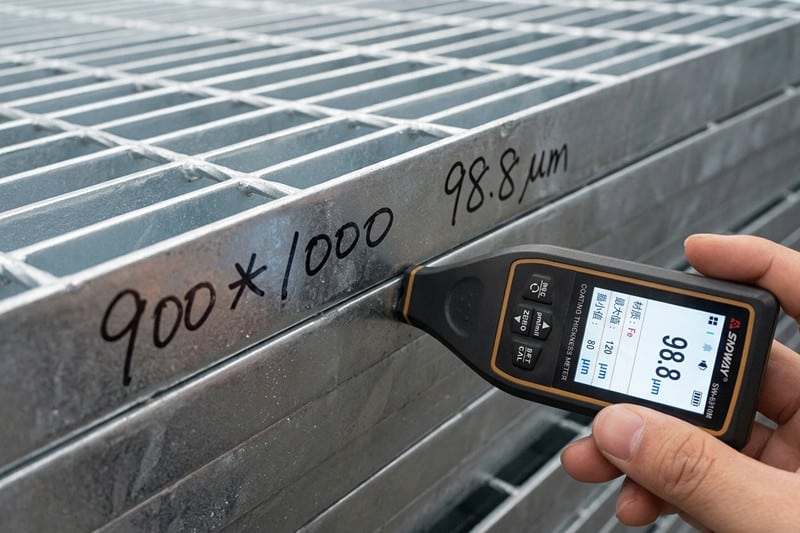
According to ASTM A123 guidelines, coating thickness is typically measured in microns (µm) and varies based on steel thickness. For structural grating, consistent coating coverage is critical in the following areas:
- Bearing bar edges
- Weld joints (high-risk corrosion points)
- Cross bar intersections
Quality control practices usually include:
- Magnetic thickness gauge testing
- Random sampling per batch
- Visual inspection for zinc drips, bare spots, or uneven coating
For B2B buyers, it is important to specify minimum coating thickness requirements in RFQs to avoid variability between suppliers.
Platform Safety Requirements for Industrial Applications
When used in elevated platforms, welded steel grating must satisfy both structural and occupational safety standards.
Key safety considerations include:
Slip Resistance
For wet or oily environments, serrated bearing bars are often preferred to reduce slip hazards.
Load Classification
Platforms should be designed based on:
- Maintenance traffic (light load)
- Equipment installation zones (heavy load)
- Dynamic load conditions (vibration, movement)
Deflection Control
Excessive deflection can cause instability perception even if structural failure is not present. Engineering design must ensure acceptable deflection limits under full load conditions.
Edge and Fixing Systems
Proper clips, weld points, or bolt-down systems are essential to prevent movement under vibration or thermal expansion.
RFQ Checklist for Buyers of Welded Steel Grating
To ensure accurate quotations and avoid production mismatches, buyers should include the following details in RFQs:
- Grating type (welded steel grating specification)
- Bearing bar size and spacing
- Cross bar type and spacing
- Steel grade (mild steel or specific structural grade)
- Galvanizing requirement (ASTM A123 or equivalent)
- Coating thickness requirement (if specified)
- Load requirement (uniform or point load)
- Span between supports
- Surface finish (plain or serrated)
- Quantity and delivery schedule
Providing complete technical data at the RFQ stage reduces engineering revisions and ensures faster production alignment.


