Understanding Slip Hazards in Industrial Environments In many industrial settings—such as wastewater treatment plants, food processing facilities, offshore platforms, and chemical plants—floor safety is not optional. Wet, oily, or chemical-exposed surfaces significantly increase the risk of slips and falls, which are among the most common causes of workplace injuries. Steel bar grating is widely used […]
Understanding Welded vs Press Locked Steel Bar Grating When engineers and procurement teams compare welded vs press locked steel grating, the decision typically comes down to application requirements, load conditions, and aesthetic expectations. Both types are widely used across industrial platforms, walkways, mezzanines, and drainage covers—but they serve slightly different priorities. From years of supplying […]
Understanding the Choice: Steel Bar Grating vs Expanded Metal When specifying materials for industrial walkways, the comparison of steel bar grating vs expanded metal often comes up early in the design phase. Both materials are widely used across manufacturing plants, refineries, water treatment facilities, and power stations—but they serve different performance priorities. From years of […]
When specifying flooring systems for industrial environments, the choice between metal bar grating vs steel plate is rarely trivial. Both materials are widely used across manufacturing plants, wastewater facilities, power stations, and logistics platforms—but they serve very different performance priorities. From a practical engineering standpoint, the decision often comes down to load efficiency, safety conditions, […]

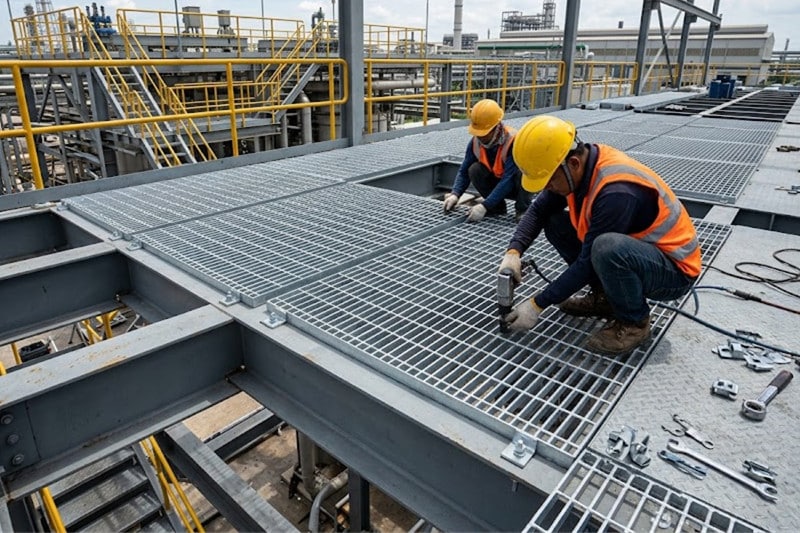
In industrial environments, proper steel bar grating installation is just as critical as selecting the right specification. Even high-quality grating can fail prematurely if installation practices are overlooked. Based on years of field experience across manufacturing plants, infrastructure projects, and offshore platforms, this guide outlines practical, proven installation tips to ensure safety, durability, and long-term […]
When specifying steel bar grating for outdoor applications, finish selection is not a minor detail—it directly determines service life, maintenance cost, and long-term safety. In real-world projects, we’ve seen identical grating designs perform very differently simply because of the finish applied. This article breaks down the most common finish options and provides practical guidance based […]
Understanding Steel Bar Grating Bearing Bar Size in Heavy Load Applications When specifying steel bar grating for industrial or infrastructure projects, one of the most critical parameters is the bearing bar size. For engineers, contractors, and procurement teams, selecting the correct steel bar grating bearing bar size is not just a design decision—it directly impacts […]
Why Opening Size Matters in Drainage Grating Design In real-world drainage projects, the opening size of steel bar grating is not just a dimensional parameter—it directly affects water flow efficiency, debris management, and long-term system reliability. From municipal trench drains to industrial wastewater channels, selecting the right opening size ensures that your drainage system performs […]
What Deflection Means in Steel Bar Grating Applications In industrial flooring systems, deflection refers to how much a steel bar grating panel bends under load. While some level of deflection is expected in any load-bearing structure, excessive movement can compromise both safety and performance. For engineers and project buyers, understanding steel bar grating deflection limits […]
Why Standards Matter More Than Most Buyers Expect In international projects, steel bar grating is rarely rejected because it “looks wrong.” It gets rejected because it doesn’t meet the specified standards. For buyers sourcing across borders, especially from Asia to North America or the Middle East, understanding steel bar grating standards is not just a […]